
Essex County Deed Records by Instrument Type
Essex County deed records live with the Circuit Court Clerk. The Clerk files and indexes every land instrument for the county. Each entry pairs a grantor, the party giving up an interest, with a grantee, the party receiving it. The index points you to deeds, deeds of trust, easements, plats, and releases. The recorded image holds the real terms. Many people search Essex County property records by address first, then trace the deed by owner of record. Always match the legal description to the parcel number before deciding who owns a property in Essex County.
| Deed Type | What It Does | Common Use |
|---|---|---|
| Deed | Records a conveyance and the described land interest | Confirm a transfer and its legal description |
| Deed of trust | Records a security instrument tied to a debt | Review an encumbrance and later satisfaction |
| Assignment | Records transfer of an interest or instrument | Follow lender or party changes in the record |
| Certificate of satisfaction | Records release of a satisfied deed of trust | Check whether a prior security instrument was released |
| Deed of easement | Records an easement interest in land | Read access or utility rights affecting a parcel |
| Foreclosure deed | Records a transfer following foreclosure | Check a distressed-property conveyance |
| Plat | Records a land division or mapped description | Match a lot or parcel change to the deed |
A deed and a deed of trust often sit in the same chain of title. Yet they prove very different things. The deed records a conveyance. A deed of trust secures a debt. An assignment may later transfer that security interest, and a certificate of satisfaction releases it. Easements and covenants can bind the land even after a new owner takes title. Read each instrument, its recording reference, and any later release. Do this instead of treating every indexed deed record as a sale.
Essex County Clerk and COVERS Access
The Circuit Court Clerk keeps Essex County land instruments at 305 Prince Street in Tappahannock. Public inspection runs during normal office hours, 8:30 a.m. to 4:30 p.m. Copies cost $0.50 per page. Essex County relies on COVERS for indexing and scanning. The clerk does not currently accept electronic recording. Original documents need proper notarization, and the clerk may require a cover sheet. Incorrect fees or missing materials can trigger rejection.
Begin with the Essex land-record page for the current document list and office route. That page lays out the county process and the copy price. It publishes no complete online coverage cutoff. Not every document image is guaranteed to appear in SRA.
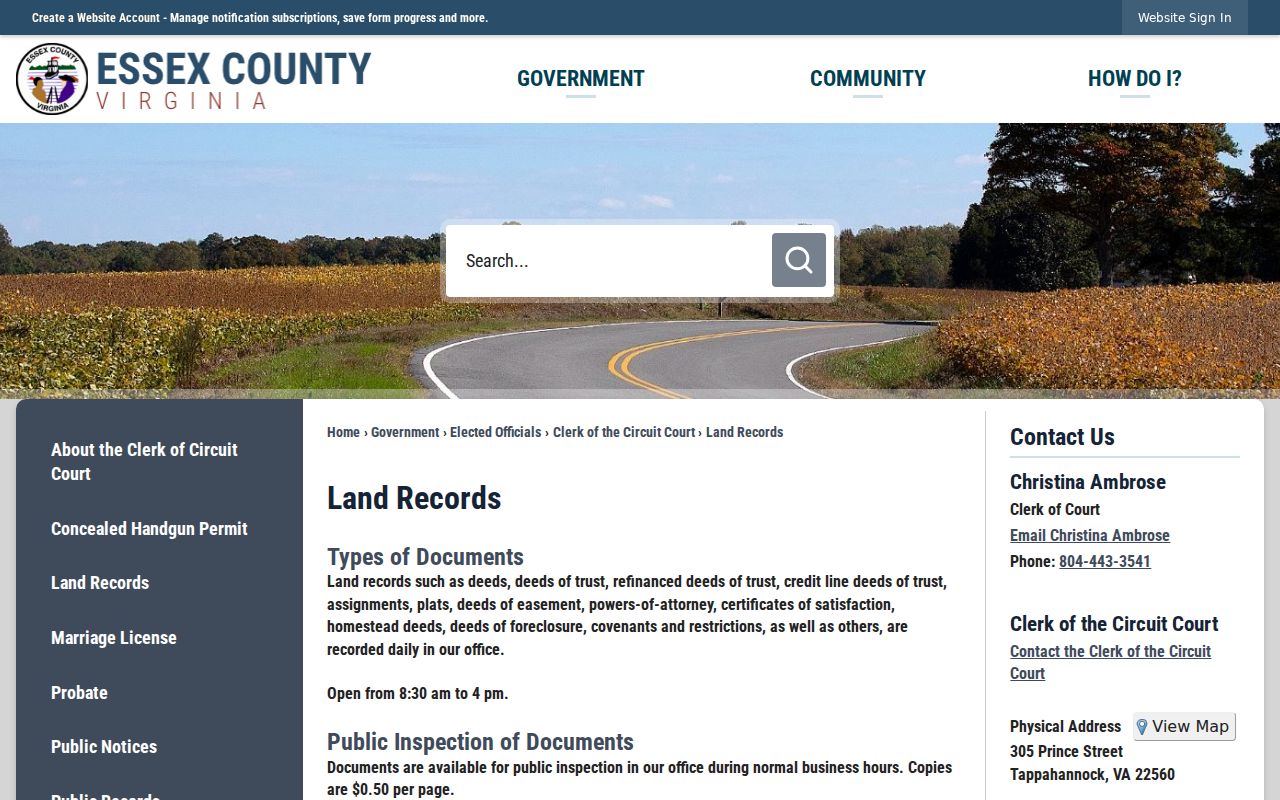
Confirm the current public-inspection procedure on the clerk's published page before you travel or mail a request.
Essex County Deed Index and Image Access
Virginia's Secure Remote Access system splits index lookup from document-image access. Index-only access may be free where Essex enables it. Images require a clerk-authorized subscription. SRA notes that coverage varies by clerk. Essex's land-record page names no earliest online year. So a deed search can identify an instrument. Its image may stay unavailable on the same screen.
When an image is not online, bring the name, date, document type, and book/page or instrument reference to the clerk. The office offers in-person inspection and copies. A missing digital image does not mean the deed went unrecorded. The Virginia SRA service description explains how index and image access differ.
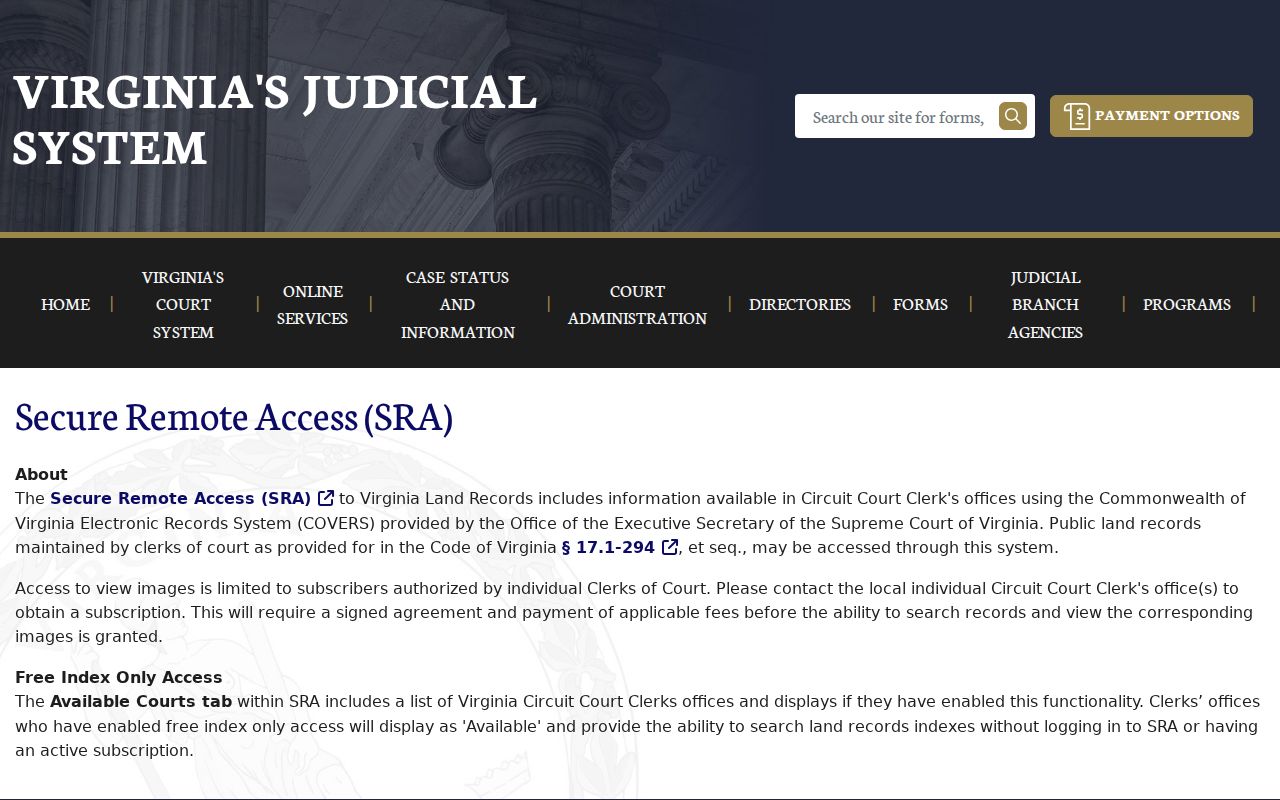
The clerk can tell you whether a particular Essex County image needs a subscription or an office copy request.
Follow the Essex County Grantor-Grantee Chain
The deed index turns on parties and recording references. The public pages do not show Essex-specific field controls in a static view. Start your deed records search with the current tax owner and legal description. Find the latest conveyance into that owner, then read the prior deed reference it cites. The grantor transfers; the grantee receives. Search that earlier grantor as a grantee to keep walking backward through the chain. Watch for entity names, co-owners, fiduciaries, and spelling variants along the way.
- Find the current owner's acquisition deed by searching the owner as grantee and checking the parcel description.
- Record the deed date, grantor, grantee, book/page or instrument reference, and any prior-deed citation.
- Search the prior grantor as a grantee in the earlier period, then repeat with the next prior conveyance.
- When online coverage ends, use the general index and deed-book or microfilm runs listed by the Library of Virginia.
- Grantor
- The party named as conveying the described interest.
- Grantee
- The party named as receiving that interest.
- Chain of title
- The linked sequence of conveyances for the parcel over time.
- Book/page
- A volume and page reference; retain it exactly as shown in the index.
Fields in the Essex County Deed Index
Live Essex SRA field labels may differ from any static description, so verify the actual search controls on the portal itself. Treat what follows as search concepts rather than a claim that Essex County displays every filter the same way. The county clerk's current page and the SRA interface are the authoritative sources for how a parcel number, name, or deed reference can be entered.
| Search item | Use in a deed search | Verified Essex note |
|---|---|---|
| Grantor or grantee name | Search a party to the instrument | Name-field controls not exposed in the static capture; try variants. |
| Instrument type | Narrow to a deed, easement, plat, assignment, or satisfaction | Recorded classes are listed by the clerk; exact dropdown is unverified. |
| Date or reference | Limit a search or retrieve a known result | Use the date, book/page, or instrument number available to you. |
| Image link | Open a scanned instrument | Image access may require clerk-authorized subscription. |
A name-only result cannot identify a parcel when owners share a name. Match the legal description or prior deed reference, then confirm against the image or an office copy.
Essex County Deed Books and Microfilm
Old Essex County property records survive in remarkably long runs at the Library of Virginia. The deeds and wills books open with a 1695-1699 volume, then a 1699-1702 one. Deed books 26 through 51 span 1752 to 1867. Books 52 through 60 carry the series to 1901. For locating a deed, the General Indexes matter most: Index 1 covers 1791-1867, Index 2 covers 1867-1904, and Index 3 covers 1904-1936. These are archival boundaries only. The county publishes no modern cutoff year for its online records, so treat these microfilm dates as separate from any digital index limit.
The Library of Virginia Essex catalog works as a finding aid, matching each deed reference to its reel, volume, and index run. Note whether a citation comes from the grantor or grantee side before requesting a volume. One more wrisk of history: Essex County formed in 1692, and the Embrey index reflects that split, covering Old Rappahannock County from 1654 to 1692 and Essex from 1692 to 1700.
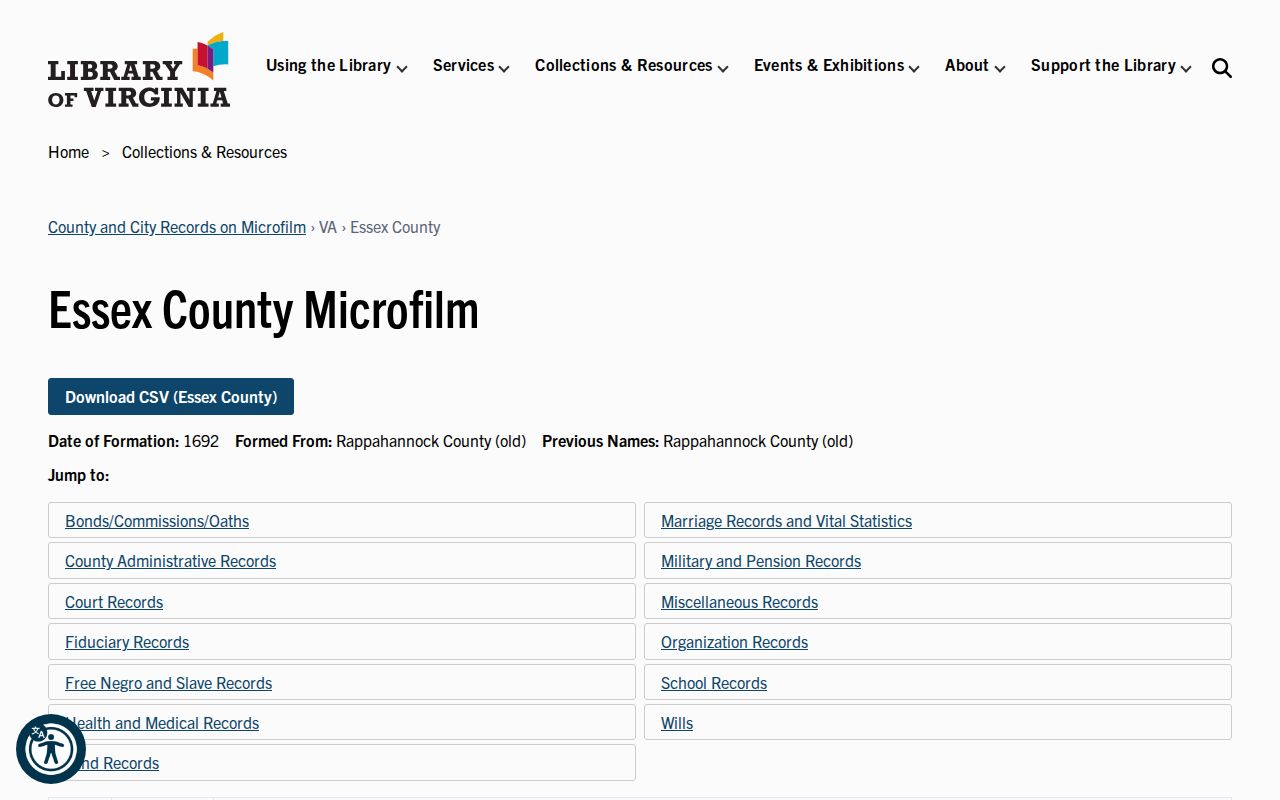
For a chain before 1692, search under Old Rappahannock as well as Essex.
Essex County Plats Need the Clerk's Process
A plat maps a lot layout or a change to land. Essex County applies its own filing rules. Plats must be originals. The office keeps two copies. A revised plat also needs sign-off from the county plat officer. The clerk will not record a plat without a deed or a confirmation of a plat. Read the deed and the plat it cites side by side. The lot description, boundary calls, and parcel identity should all line up.
Divisions under five lots count as minor subdivisions, which get administrative approval. Six or more lots are major subdivisions, and those need Board of Supervisors approval. Lot counts accumulate for every division since February 17, 1988. A boundary-line adjustment simply moves or removes a property line. These planning labels explain why a later deed might cite a new plat. The clerk's recorded instrument is what confirms the filing. When a deed depends on a plat, match the legal description and recording reference across the county GIS and the clerk index alike. A webmap outline is handy, but it is no substitute for the original drawing.
Copy and Recording Costs in Essex County
Public copies in Essex County run $0.50 per page. Recording a new deed costs more. It is a separate charge entirely. Virginia's deed-fee calculator works from the deed type, grantor and grantee exemptions, consideration, value, later recordation, locality share, pages, and any oversized-plat details. The total shifts with those inputs, so run the numbers rather than assuming one flat fee covers every transfer.
The Virginia deed-fee calculator gives an estimate. It cannot replace the clerk's guidance on originals, notarization, cover sheets, or plat approval. When ordering a copy, cite the exact record reference. Ask whether a certified copy is available and what extra terms apply.
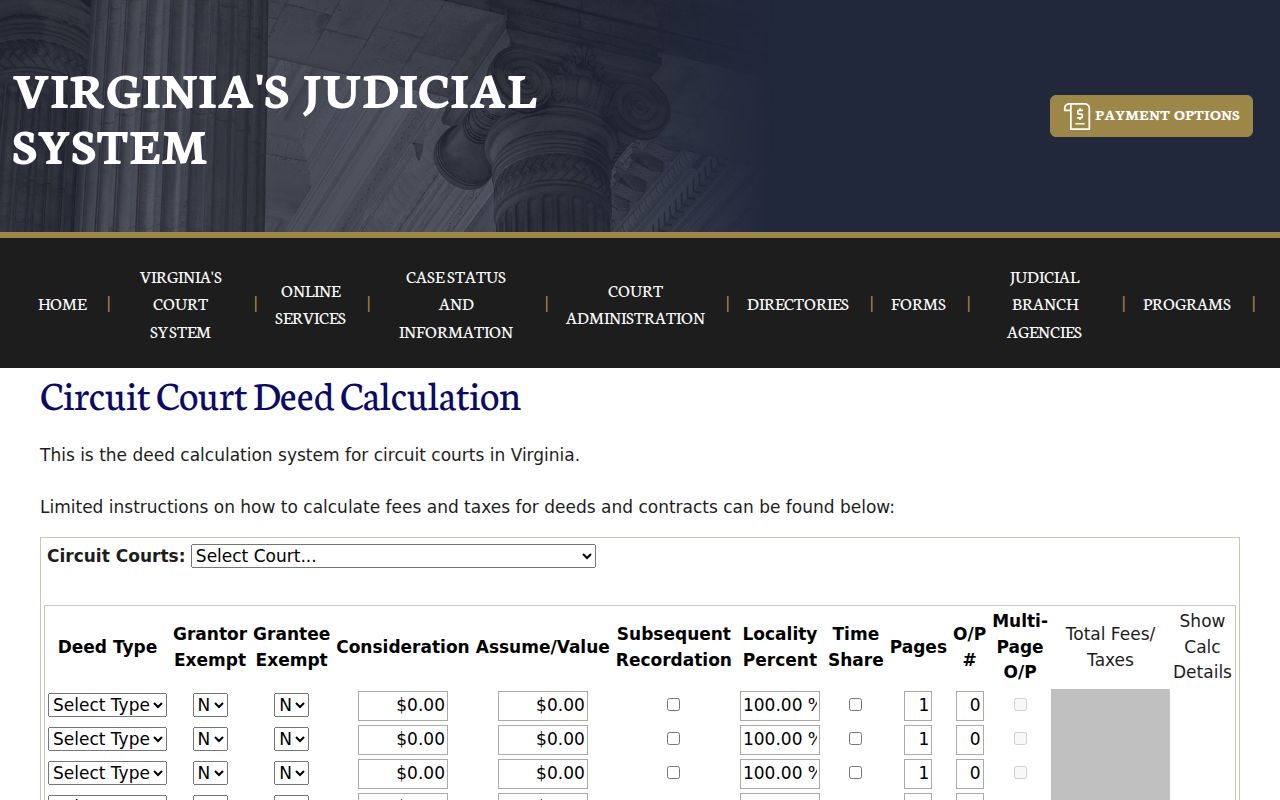
Keep the per-page copy fee separate from the charge for recording a new instrument.
Get an Essex County Deed Copy
Gather the party names first. Add an approximate date, the document type, and the book/page or instrument reference. See if an image is available through SRA. If not, use the clerk's public-inspection route or contact the office directly. Public copies cost $0.50 per page. The land-record page lists the Circuit Court Clerk's address and phone. Ask about a mail-order form and certified-copy options when you call.
Older volumes usually live in the Library of Virginia catalog. Find the catalog entry, reel, or book number before asking where to view it. Some entries are microfilm or transcript runs rather than a current online document. The clerk can say where a copy comes from. It may be the local office or an archival source.
Recorded, not guaranteed. The index shows instruments of record; it does not establish that no unrecorded claim exists or that title is clear. A complete title review uses the chain, related liens, releases, plats, and any relevant court record.