
Essex County Property Value Types
Essex County values real property at one hundred percent of fair-market value for tax purposes. That ratio is not an appraisal. It also does not promise a sale price. An assessment card, a deed, and a private appraisal each answer a different valuation question on its own date, so treat them as separate records rather than one figure. Start by asking what question each number was meant to answer.
| Value | What It Is | Where |
|---|---|---|
| Assessed value | Tax valuation at the county's stated 100% fair-market standard | Commissioner of the Revenue / Vision |
| Market estimate | Value indication from sales review and valuation models | Assessment process; not a private appraisal |
| Recorded consideration | Value or consideration associated with a conveyance where stated | Recorded deed and deed-fee calculation context |
| Land and improvements | TotalLand, TotalImp, and TotalParc components | Assessment card and ArcGIS parcel fields |
An assessment card carries the figure used to assess property. A recorded consideration comes from the transfer document. A private appraisal answers a separate valuation question. Even at a one-hundred-percent ratio, these numbers rarely match. The dates and purposes behind them differ. The accessible Vision result does not expose a sale price as a separate verified field. Check the deed and its instrument context for what a transfer actually stated.
Find an Essex County Assessment Value
Vision hosts Essex County's assessment database with its 2025 value update. Searches run by address, owner, Acct#, Mblu, PID, or All. Confirm the parcel identity before reading the value. The ArcGIS field inventory labels the assessed land, improvement, and total parcel amounts as TotalLand, TotalImp, and TotalParc. Those components show how the assessment is divided. But none of them is a sale estimate.
- Search the property in the Vision Essex County database using the address, owner, PID, Mblu, or Acct# you have.
- Confirm PID, LegalDescr, and situs address before writing down the assessment figures.
- Read TotalLand, TotalImp, TotalParc, and the assessment year as separate pieces of the tax valuation.
- For a transfer amount or deed date, locate the recorded conveyance through the Circuit Court Clerk.
- Assessed value
- The value entered on the local assessment roll for tax purposes.
- Market value
- A value estimate for the property; the assessment is not a private appraisal.
- Assessment ratio
- The relationship between assessed value and the jurisdiction's market-value standard.
- Reassessment
- A periodic update of the county's property valuation and assessment record.
Limits of an Essex County Property Value
The Essex County assessment exists for taxation. It is not a promise of what a parcel would sell for. Mass-appraisal work, sales review, data review, and valuation models produce the figure. It applies as of the stated reassessment date. The Vision card publishes no exact field for a last-sale date or price. Use the recorded deed rather than assuming the live card holds a complete sale history. The deed records the transfer; the assessment records the taxable value.
Value vs price. An Essex County assessment is not an offer, a sale result, or a licensed appraisal. For a transaction that needs a market opinion, consult a qualified appraiser.
Essex County's 2025 Value Cycle
Essex County's 2025 reassessment followed a four-year cycle. It took effect on January 1, 2025. The Vision landing page states that the database is updated for 2025 under a one-hundred-percent fair-market-value standard. County project material describes data review, sales review, land and building valuation models, and informal hearings.
A card that seems out of step deserves scrutiny. Compare the land and improvement entries. Keep the assessment notice too. The county page mentions informal review and the Board of Equalization. No full local filing calendar is posted. Virginia requires mailed notice of a reassessment at least fifteen days before the hearing date. After that notice, the appraisal card and working papers behind the value can be inspected, subject to protected material. The four-year cycle sets the county's general reassessment interval. It does not mean every property moves by the same amount, or that a single building is revalued only once in four years.
The Vision landing page displays the 2025 update statement. Read the effective year beside any amount so an older tax book is not mistaken for the current card.
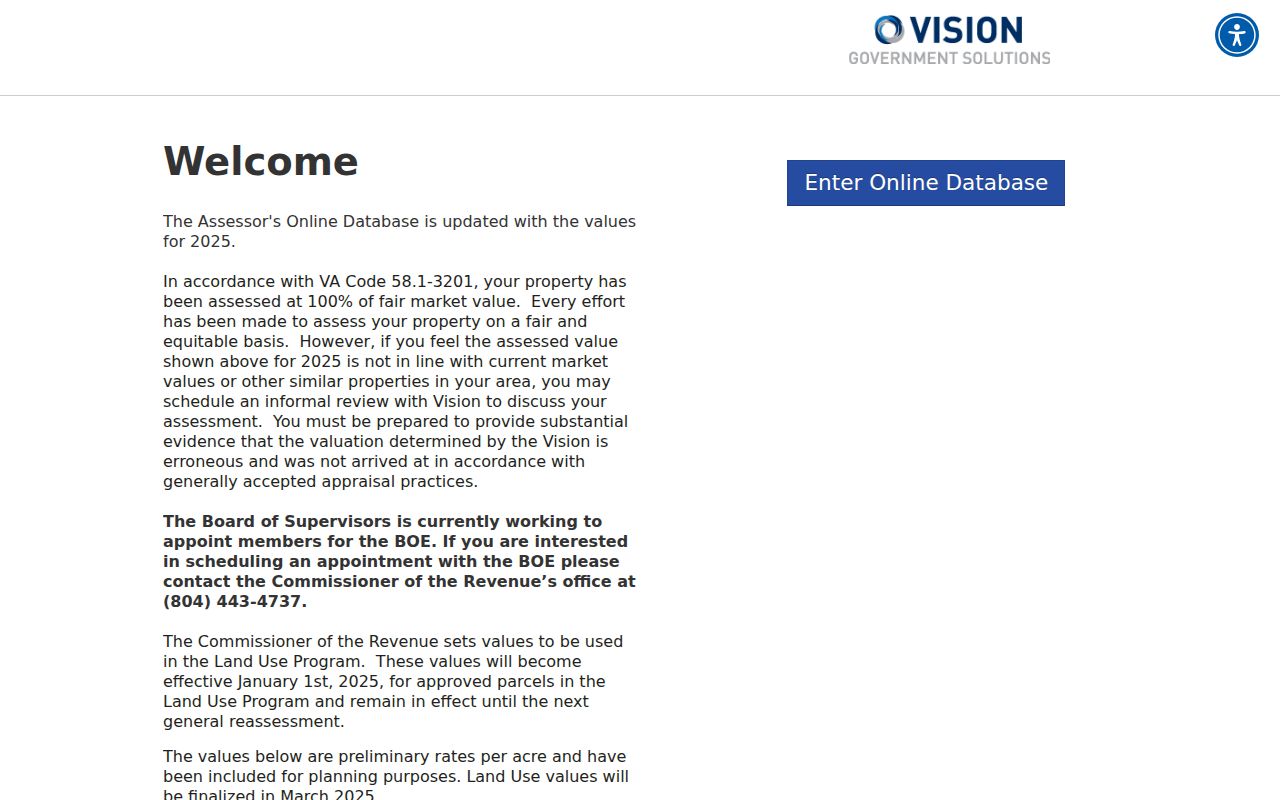
Check the effective year beside the amount. An older tax book can otherwise be mistaken for the current assessment card.
Essex County Land and Improvement Values
Essex County parcel data splits the assessment into three parts: TotalLand, TotalImp, and TotalParc. The first is the land component. The second covers improvements. The third is the total parcel assessment. These numbers describe the assessment structure rather than three sale prices, and one component can rise while acreage and legal boundary stay the same.
LegalAcre and GISAcres distinguish legal acreage from mapped geometry. A gap between them often reflects a record or mapping distinction rather than a new market value. When acreage or shape seems wrong, set the assessment card beside the deed and the plat.
The Essex parcel field inventory defines the value labels.
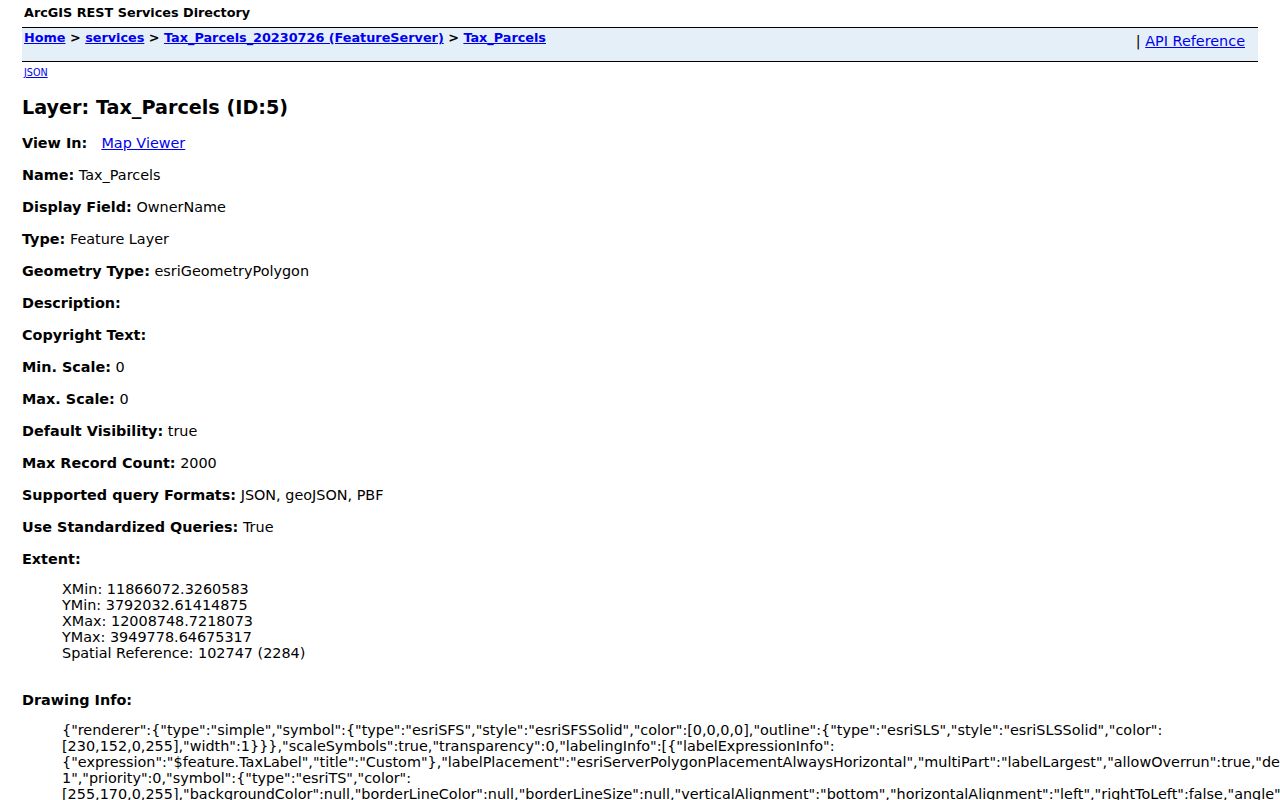
Use the field names when comparing GIS and Vision values.
Essex County Assessment Ratio and Tax Rate
A ratio and a rate are different numbers. Essex reports real property at 100% of fair-market value, a ratio that describes the valuation level. Its 2024 real-estate rate was 55 cents per $100 for the county and 9 cents per $100 for Tappahannock. The rate is a levy applied to the assessed amount. Town and county are separate taxing entities.
For an address near Tappahannock, rely on the corporate-limit layer rather than a ZIP or mailing city to decide whether the town rate applies. Match rates to the right year and jurisdiction. The tax amount due is a separate collection record. That account sits with the Treasurer.
The county tax-rate table lists the assessment ratio and the 2024 county and town rates.
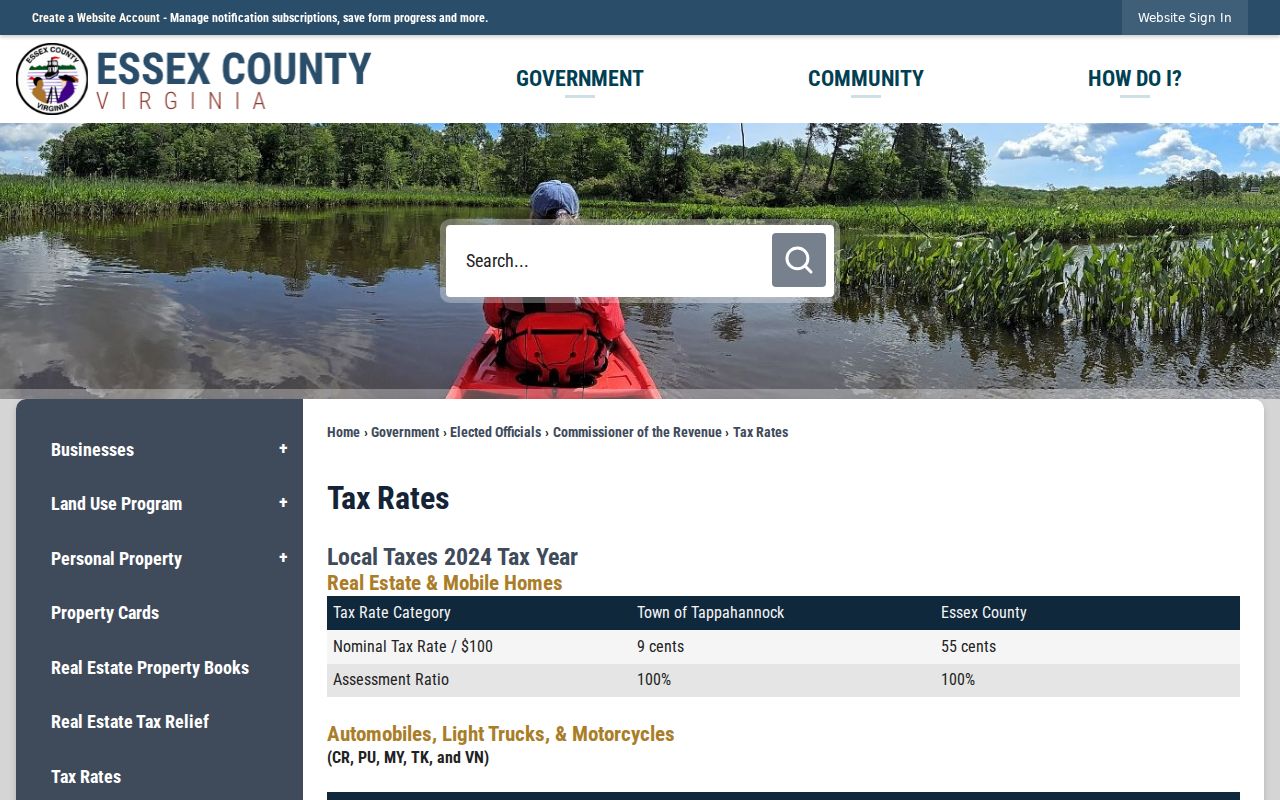
The table's year matters in any comparison. A nominal rate can change while the assessed value follows its own reassessment cycle.
Recorded Consideration and Essex County Value
A deed records a conveyance, and Virginia's deed-fee calculator uses consideration or actual property value as applicable to compute filing charges. That figure is not the market price on the assessor card. Pull the deed first. Read its parties and legal description, then interpret any stated consideration in light of the whole instrument. A mortgage amount is not a sale price. Neither is a deed-of-trust obligation.
The assessor's 2025 value answers a tax question. A deed amount relates to a recorded transfer, while a private appraisal answers a valuation assignment. The dates and purposes differ. The deed-fee calculator's inputs help explain why filing taxes are not interchangeable with the property's assessed value. The Virginia deed-fee calculator identifies consideration and value inputs.
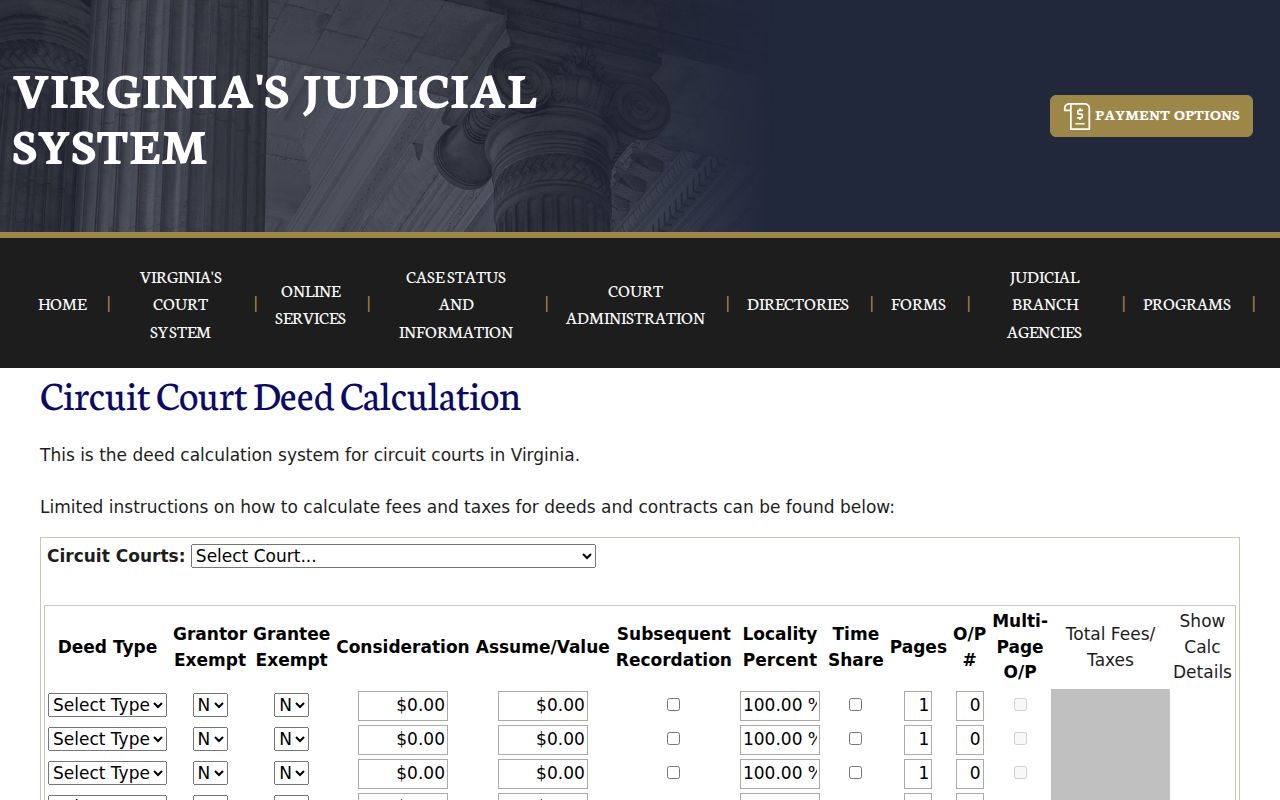
For ownership history or a document copy, work from the deed index instead. A calculated fee is not a market estimate.
Essex County Land-Use Values and Books
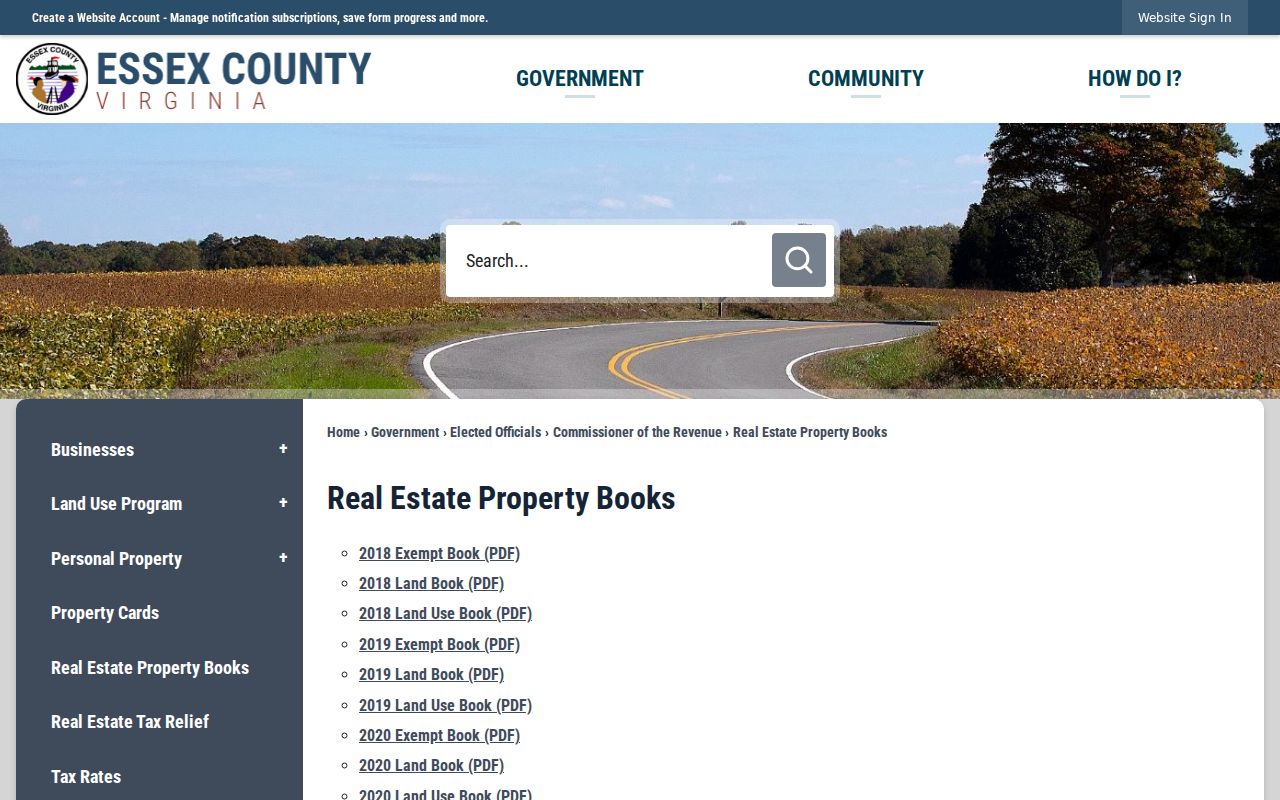
Essex County publishes land, land-use, and exempt books each year. The county page lists land and exemption books for 2018 through 2026. Land-use books cover most years. Land-use value sits apart from an open-market price. The county also explains rollback taxes when property leaves the land-use program. Check the year and book type before comparing any amount with the current Vision card. A book entry is a historical assessment record. It is not proof of the deed owner or a new boundary. When a land-use status or parcel split affects value, set the current assessment record beside the relevant plat. Pair it with the recorded conveyance. The property-books index lists the annual downloads.
Land-use classification is not a personal-property exemption. It is not a market-price adjustment either. Essex's published land-use books and rollback-tax explanation cover a program with its own eligibility rules and tax consequences. If a parcel changes use or exits the program, ask the Commissioner how the classification applies to the specific assessment year. Ask how any rollback calculation applies too. Do not estimate from the map alone.
For a written explanation of a value, ask the Commissioner for the parcel's appraisal card. Also request the working papers behind the reassessment figure. Virginia's assessment law sets the general fair-market-value standard. The locality applies its own data and models to the parcel. Comparable sales may support a review. Even so, sale price, assessed amount, and a private appraisal remain distinct figures with different dates and purposes.
Use a same-year comparison when following the assessed value across the county's published books.