
Essex County Property Tax Record Fields
Assessment and collection records overlap, but they live in different hands. The Commissioner of the Revenue maintains the values; the Treasurer handles the money. In Essex, the Vision database lists values updated for 2025. Those values are assessed at one hundred percent of fair-market value. The Treasurer's side of the ledger covers balances, accepted payment methods, and due dates. Essex also posts its land, land-use, and exempt books by year. Before comparing any figure with a deed price or a balance due, check something first. Check which office produced the number.
| Field | What It Shows | Where |
|---|---|---|
| TotalLand / TotalImp / TotalParc | Assessed land, improvement, and total parcel values | Vision parcel card and ArcGIS field inventory |
| 2025 assessment | Tax valuation at the county's stated 100% fair-market level | Commissioner of the Revenue / Vision |
| Land-use or exempt book | Yearly land and exemption records where published | County property-books page |
| Tax balance and payment | Amount due and payment status | Essex County Treasurer / WIPP |
| County and town rates | Nominal rate per $100 of assessed value | County tax-rate page; separate town and county levies |
Essex uses a one-hundred-percent assessment ratio. That means the assessed figure is set at the jurisdiction's fair-market-value standard for taxation. Remember, it is a mass assessment. It is not a private appraisal, and it is not a guaranteed sale price. The tax bill itself is simply a calculation built on taxable value and the applicable levy, so a payment receipt proves neither ownership nor the release of unrelated liens.
Find an Essex County Tax Bill
The Treasurer collects real-estate taxes and offers the online WIPP payment route. Payments are also accepted in person, by mail, and at a 24-hour drop box. For a current balance or payment status, use the Treasurer account. For assessment values and parcel characteristics, use Vision. If the online account shows no balance, ask the Treasurer directly. Do not assume the account is clear.
- Open the county Treasurer page and follow its WIPP link to the Essex payment application.
- Use the property or account details requested by the payment system and compare the parcel with the Vision card.
- Read the amount due and payment status as a collection record, not as proof of title or absence of other liens.
- If a delinquency or tax-sale status is not shown, call the Treasurer at 804-443-4371 for current information.
- Assessed value
- The value placed on the property for the local tax roll.
- Levy
- The local tax rate applied per $100 of assessed value.
- Land-use value
- A land assessment category with its own book and rollback-tax rules.
- Tax balance
- The Treasurer's collection figure; it does not describe deed ownership.
Review an Essex County Assessment
The 2025 Vision page notes that an informal review may be scheduled. It also points owners toward the Board of Equalization. The full local filing deadline, form, hearing location, and escalation schedule are not posted. Virginia law does give owners access to appraisal cards and the working papers behind a value after reassessment notice. Before filing anything, ask the Commissioner about Essex's current process. Do not rely on a general statewide date.
Appeal window. Confirm the current Essex County informal-review and Board of Equalization dates with the Commissioner. Preserve the notice, Vision card, land and improvement values, property details, and comparable sales; the county says an informal review needs substantial evidence of an error or a departure from generally accepted appraisal practices.
Essex County's 2025 Reassessment
Essex County's 2025 reassessment took effect January 1, 2025. A reassessment can move the value on the tax roll. The physical parcel may not have changed at all. County project material and the Vision landing page describe a four-year cycle. Values were updated for 2025 under a one-hundred-percent fair-market-value standard. The process covered review of property data and sales. It also covered land and building valuation models and informal hearings.
If a figure looks wrong, keep one file. Put the assessment notice, the Vision card, property characteristics, and comparable sales together in it. Virginia law requires mailed notice of a reassessment or other value change. It must arrive at least fifteen days before the hearing date. Once notice arrives, appraisal cards and working papers are open for inspection, subject to protected material. Essex does not publish a full local appeal calendar or form. Contact the Commissioner or the Board of Equalization for the current steps. The Vision assessment landing page carries the 2025 status and the informal-review note.
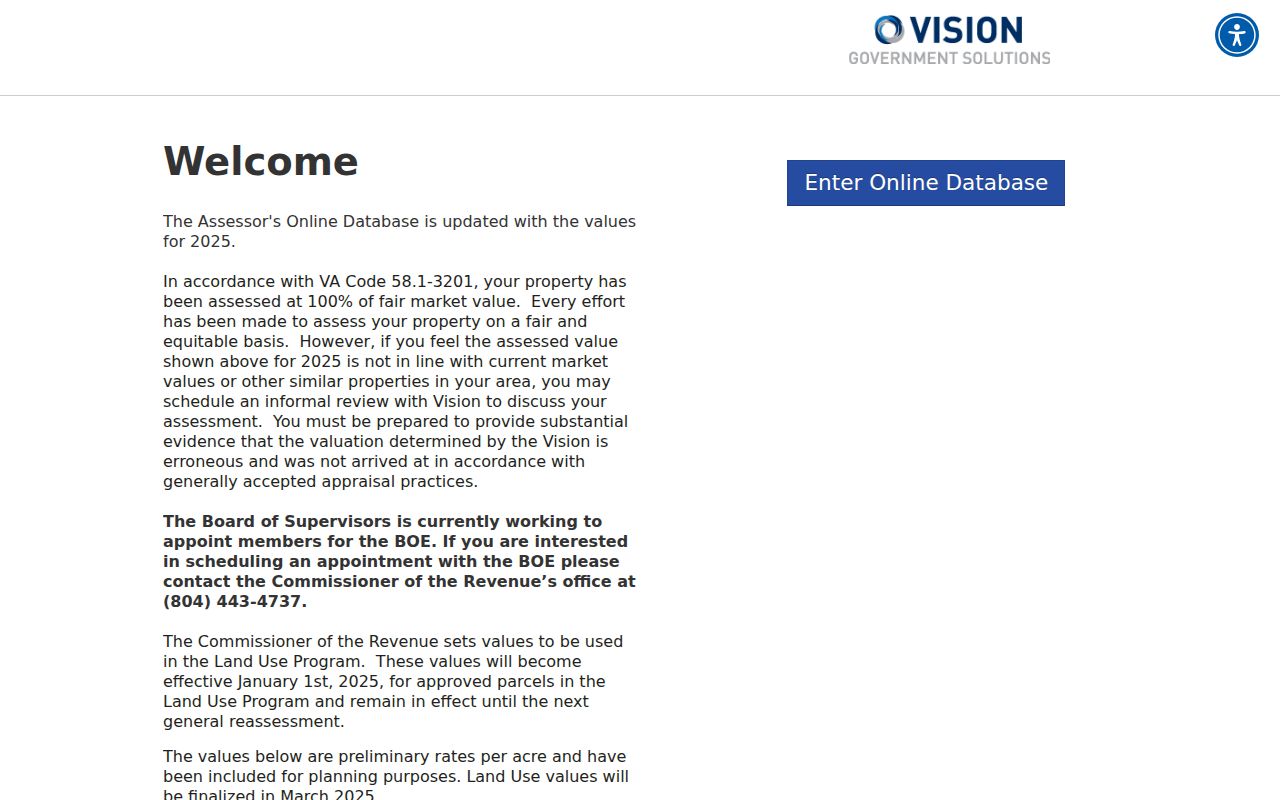
Always check the effective year before comparing an online card against an older printed land book.
Search Essex County Assessment Records
Vision accepts several search modes: Address, Owner, Acct#, Mblu, PID, and All. Its segmented Mblu entry breaks the parcel number into Map, Map Cut, Block, Block Cut, Lot, and Unit Cut. It breaks Unit into its own field too. An address is a fine starting point. Just know that the parcel layer may display only one 9-1-1 address when several exist. Rural parcels without an assigned 9-1-1 address can show up as 0 Road Name.
| Vision mode | Search key | Tax-record use |
|---|---|---|
| Address | 9-1-1 situs address | Open the likely parcel card; compare its PID and legal description. |
| Owner | Person or entity name | Find the assessment-side owner listing, including a co-owner where shown. |
| Acct# or PID | Account or parcel key | Carry the parcel between Vision and GIS. |
| Mblu | Map, block, lot, and unit segments | Use the exact mapped identifier displayed by the portal. |
The county's property-books page lists land and exemption PDFs spanning 2018 through 2026, plus land-use books for most of those years. When the current assessment card cannot answer a question about a historical tax roll, these books are a practical fallback. The Essex County property books page identifies each downloadable year and book type.
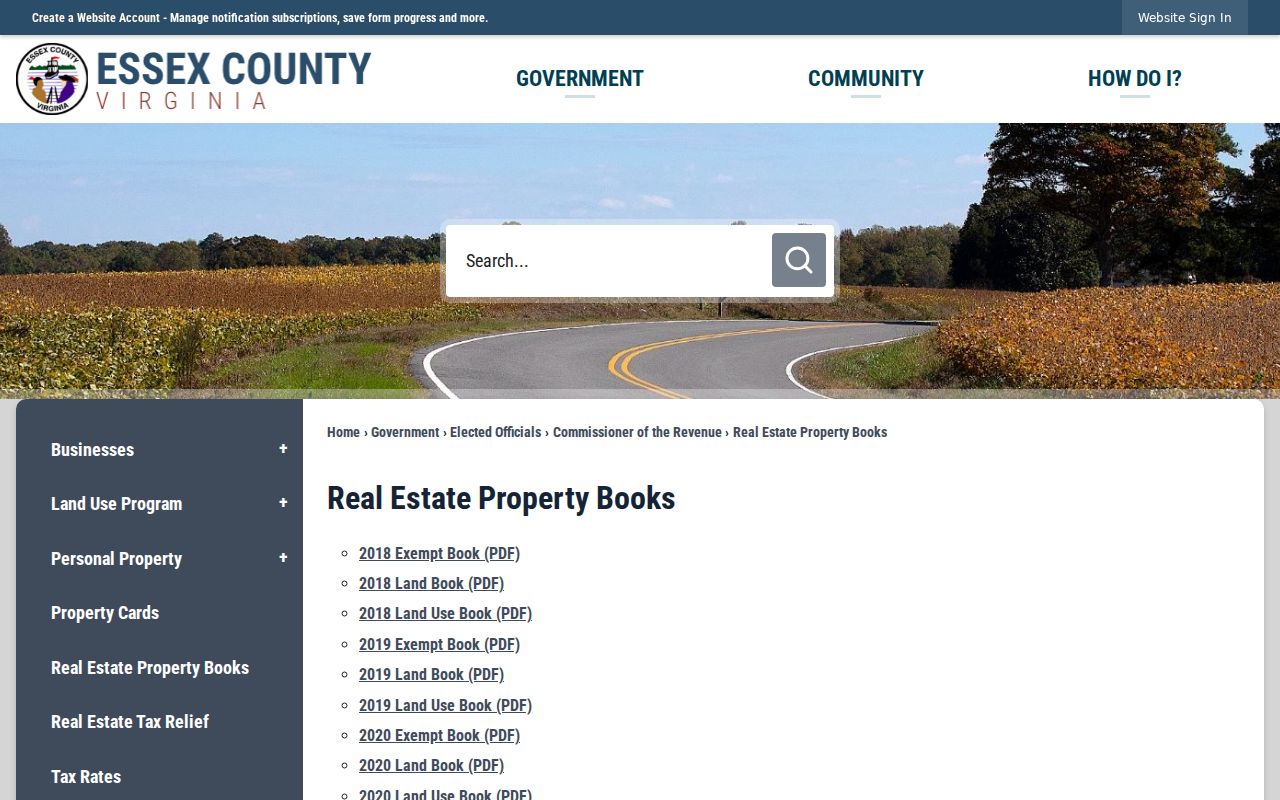
Match the book year and category to your specific question before trusting any single row.
Essex County Property Tax Dates and Fees
Essex County collects real-estate and personal-property taxes in two installments, due June 5 and December 5. The Treasurer takes payment four ways. Mark both dates. Bring payment to 321 Prince Street, mail it to P.O. Box 489, pay online through WIPP, or use the 24-hour drop box. Convenience fees are separate from the tax principal. Cards add 2.95 percent. An e-check adds $1.95, and a returned e-check costs $25.
The official Essex County Treasurer page carries the current instructions and is safer than an old notice. The 2025 notice repeats the December deadline and the same fees, and the county posts no delinquent-property list or tax-sale calendar online. Ask the Treasurer about a possible arrearage.
Mailed payments go to P.O. Box 489, with the public contact address at 321 Prince Street. Both addresses serve different purposes. Include the tax-account information from the bill. The drop box and the WIPP portal both deliver payment, but a pending transaction is not a posted receipt. Keep the confirmation. Online and mailed payments post at different speeds. Ask the Treasurer to trace a payment if the balance does not update as expected. The Treasurer's due-date notice lists the June and December deadlines shown here.
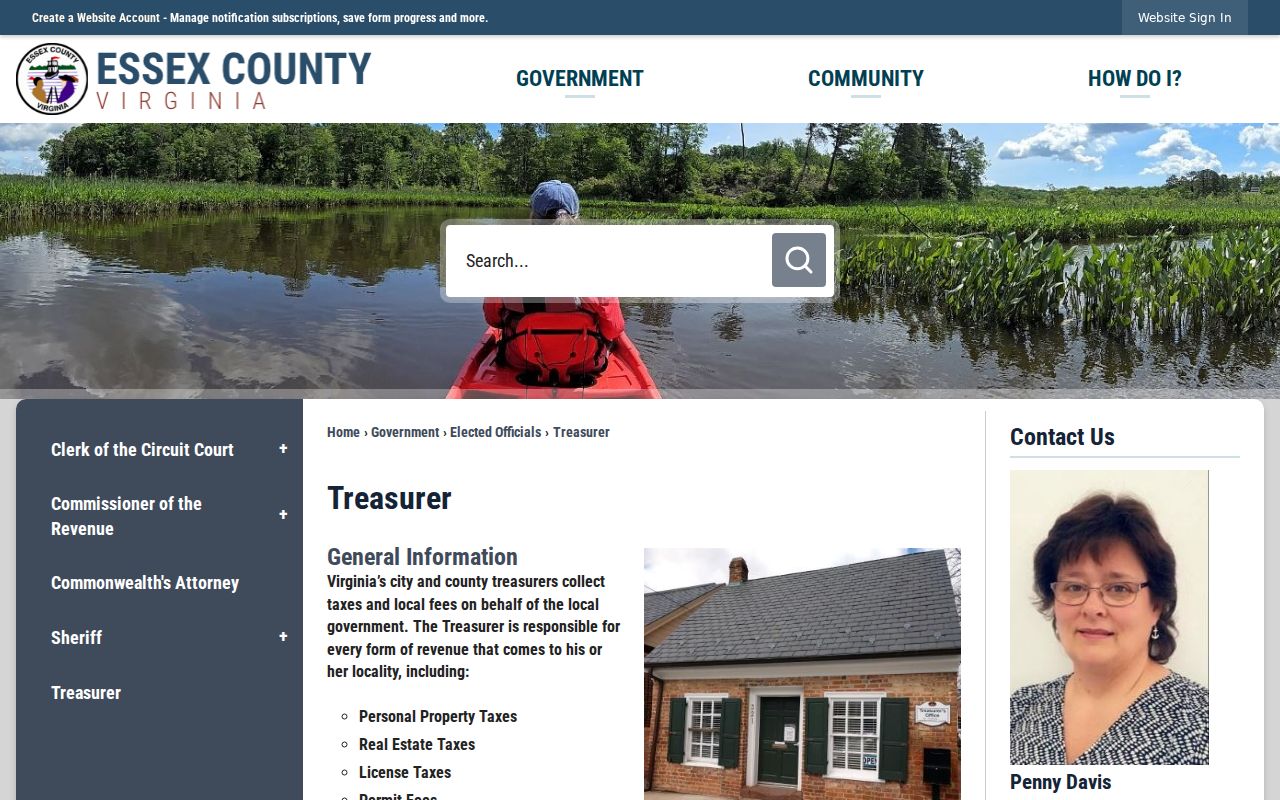
Keep the payment confirmation and the account identifier handy. They make a trace possible if a balance looks wrong. Essex County's WIPP payment portal is the online route the Treasurer describes. Its payment screen stands apart from the assessment lookup. Use it with the correct tax account.
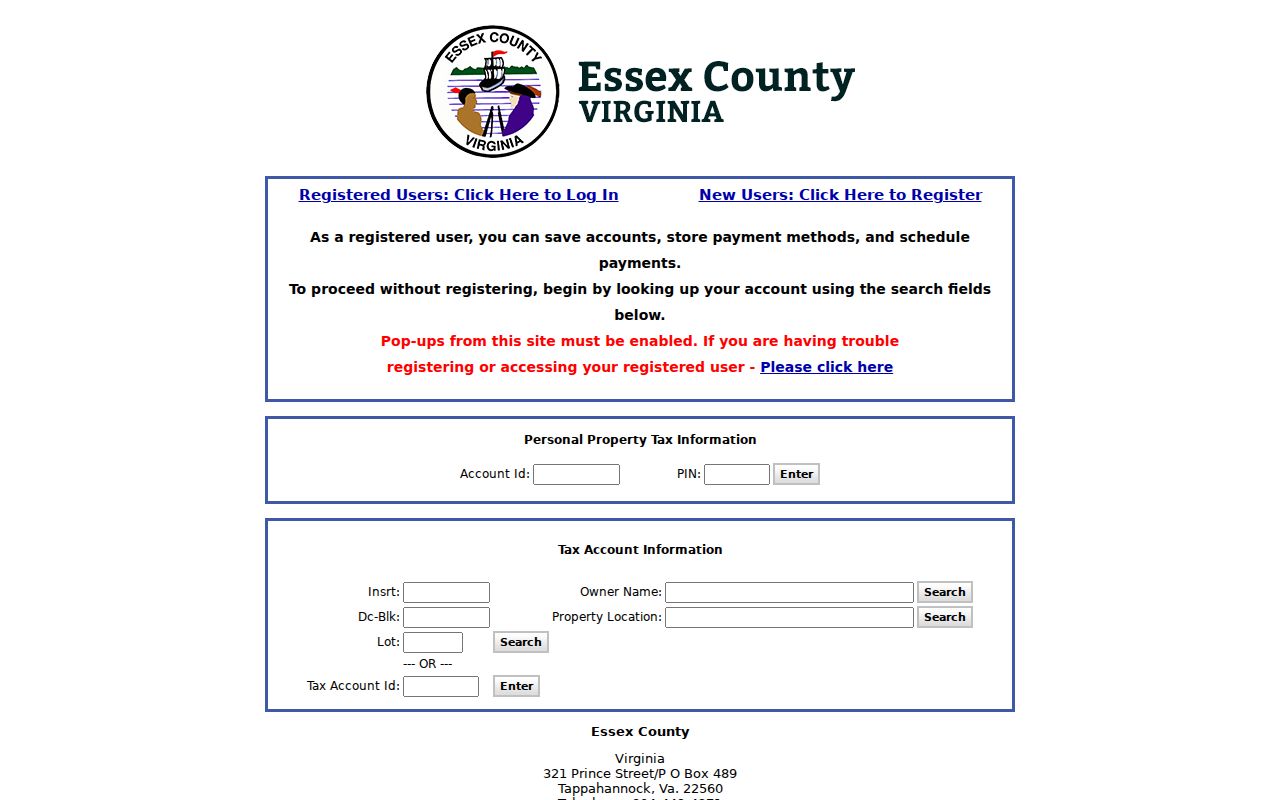
Check the payment total and any service charge before submitting an online transaction.
Essex County and Tappahannock Tax Rates
Essex County set its 2024 real-estate rate at 55 cents per $100 of assessed value. Tappahannock added a town rate of 9 cents. Both used a 100 percent assessment ratio. Virginia counties and towns are separate taxing entities, so corporate-limit status decides which levy applies to an address. A Tappahannock mailing address alone proves nothing about town limits.
Check the county corporate-limit and zoning layers when a parcel sits near town. Match the rate to the assessment year. One tax bill can carry more than one local levy. A rate comparison is not a sale-value estimate. Nor does it change the parcel's deed chain. The county tax-rate table lists both figures and the ratio.
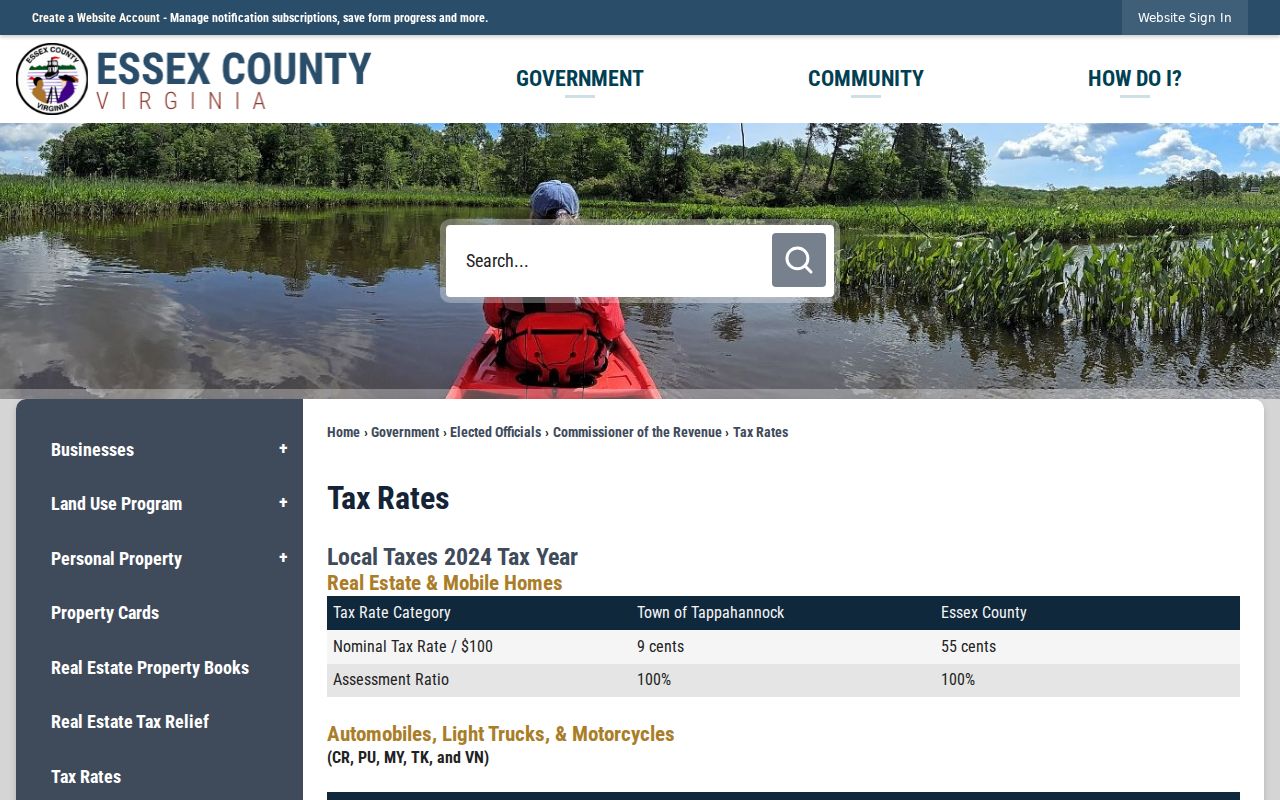
Check the table's year before applying a rate to a current account.
Essex County Land-Use and Rollback Tax
Essex County publishes land-use books plus a separate rollback-tax explanation. Rollback taxes apply when property leaves the land-use program. The county page spells out the assessment and tax consequence. A lower land-use figure is neither a mistake nor a permanent exemption. Check the classification and years in the books. Then confirm current status with the Commissioner.
Read the rules and assessment card together. A land-use entry does not change the recorded owner or create a boundary. If a division or ownership transfer touched the parcel, keep the deed and plat references alongside the tax-book entry. Essex County's rollback-tax page explains the local program.
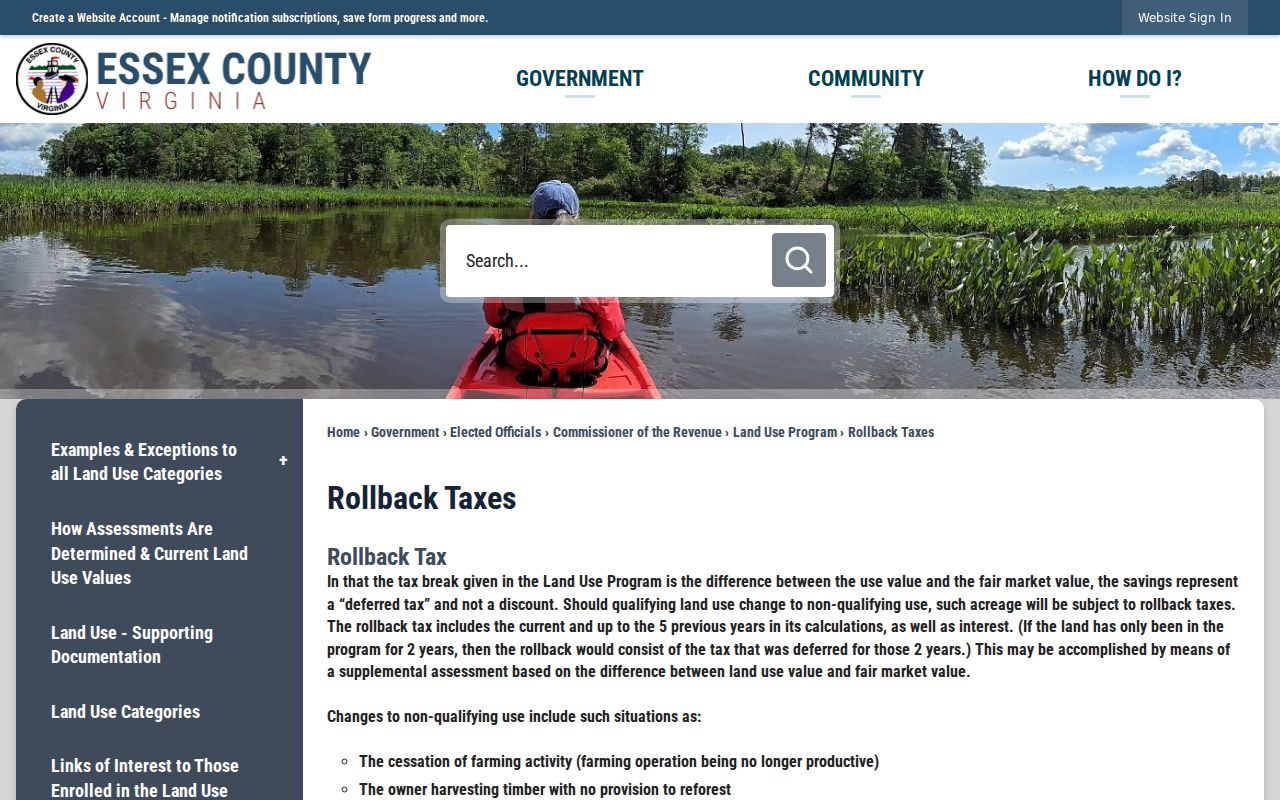
Confirm land-use changes and rollback estimates with the Commissioner.
Essex County Land Books by Year
The county's downloadable property-books page lists annual land and exemption books from 2018 through 2026, with land-use books for most years. A book shows what the county listed in a past tax year. The live Vision card only displays the latest assessment. A land book is a historical roll, not a deed. The 2025 land book is one published example. Open the book whose year matches the valuation or tax record in question.
Compare owner name, parcel identifier, land-use classification, and assessment components across the years. A changed owner name may reflect a recorded transfer, a roll update, or an entity-name correction. Confirm transfers through the Circuit Court Clerk.
The book index separates land books, land-use books, and exemption books. Choose the category matching the question. The Commissioner of Revenue maintains the assessment, while the Treasurer handles billing, payment posting, and any balance due. A tax-book value explains the basis for a bill. Payment status still comes from the Treasurer's account.
A year-by-year comparison tracks the assessment record. It does not trace the full market history.